
LinearB has introduced a unified User Management interface that streamlines how admins view, manage, and edit users and teams. This migration consolidates previously separate settings into a single, simplified experience.
Overview
- User and team management is now centralized under Settings → Users & Teams.
- User invitations, merging, filtering, and billing visibility are handled in one place.
- New filters and a status line replace legacy Git and team-based filters.
- Admins can also delete users and restore deleted users from the same area.
- Your purchase licences are only applied to a user on team.
What’s changing
The new UI introduces the following updates:
| Feature | Previous UI | New UI |
| Navigation | Users under Settings | Users moved to Users & Teams |
| Tab name | People & Teams | Users & Teams |
| User list | Contributors separate from Users | Unified Users (users + contributors) |
| Filtering | Git connection + In team | Status line + Billable Users |
| User invitation | Invite User flow | Add User workflow |
| User merge | default: Auto merge + Manual per profile available | Merge Account from user list |
Unified access: Users & Teams
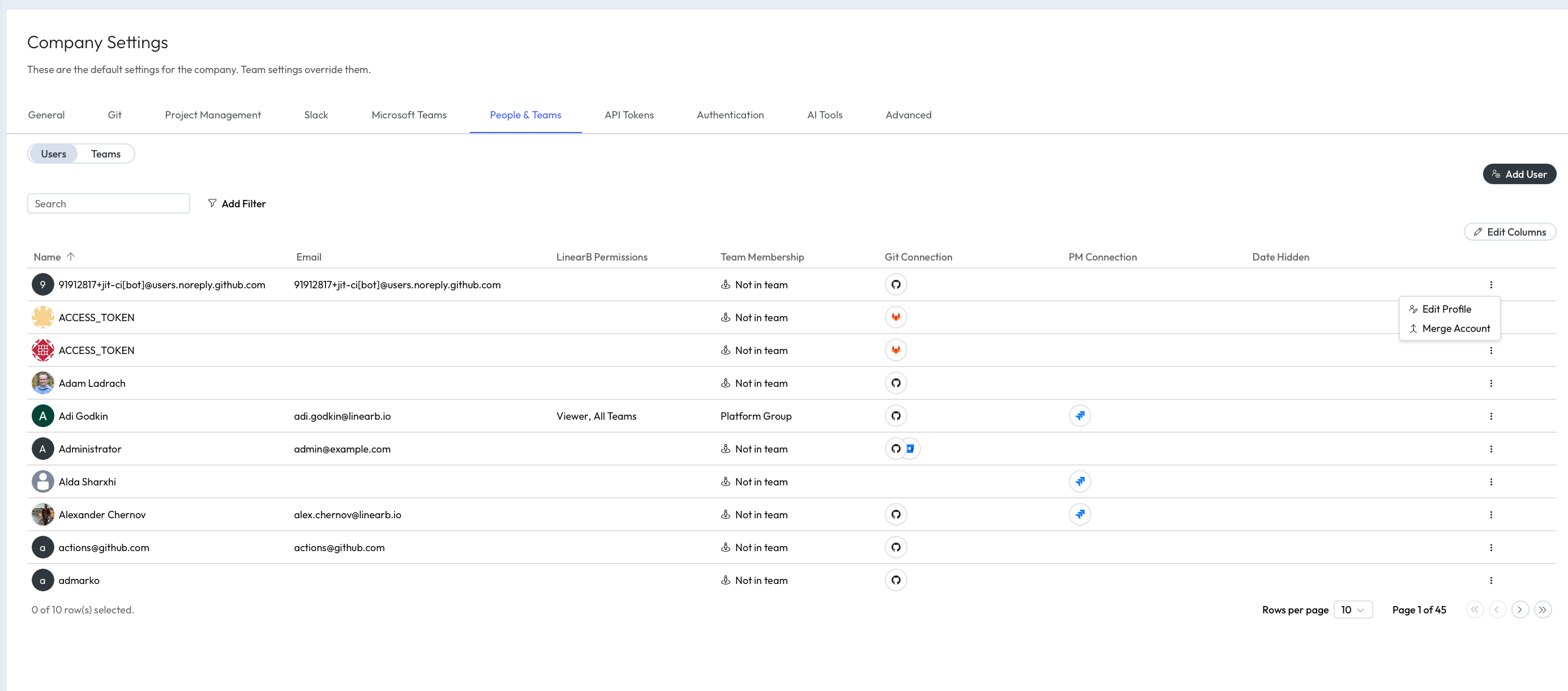
All user management is now centralized under Settings → Users & Teams. You no longer manage users separately from teams—contributors, integrations, and seats are all visible in the unified Users table.
Updated Users table
The renamed Users table now includes:
- Role-based permissions (Admin, Editor, Viewer)
- Git and project management connections
- Team membership and scope
- Inline profile editing and merge actions
Adding Users
How to add users
Instead of the legacy invitation flow, admins now add users directly:
- Go to Settings → Users & Teams → Users.
- Click Add User.
- Enter name, email, and role.
- Define team scope and membership.
- Click Save and Close.
Merging Users
How to merge users
The Merge Account action is now available directly from the user list, enabling faster cleanup of duplicate or platform-linked users.
- Click the ⋮ menu next to a user.
- Select Merge Account.
- Choose the duplicate account.
- Confirm the merge.
Primary user behavior in merged accounts
When users are merged in the unified User Management UI, one account is designated as the primary user.
Primary user selection
- The primary user is the account selected when opening the merge screen.
- The primary user becomes the authoritative identity after the merge.
- In a future update, admins will be able to change the primary user during the merge process.
Identity and visibility
- The primary user’s details (name, email, avatar, and permissions) are shown throughout the platform.
- This includes teams, dashboards, metrics, alerts, and pull request ownership.
Team memberships
- The merged user becomes a member of all teams associated with any of the merged accounts.
- Example:
- User A belongs to Team 1
- User B belongs to Team 2
- The merged user belongs to Team 1 and Team 2
Permissions
- The merged user inherits only the permissions of the primary user.
- Secondary accounts are retained behind the scenes for data continuity with basic permissions.
- Permissions are not combined across merged accounts.
Platform users
As part of the unified User Management experience, LinearB now treats each person as a platform user.
A platform user represents a single, unified identity in LinearB, even if that person was previously represented by multiple accounts due to different emails, integrations, or login methods.
Merging users ensures:
- A single identity across all LinearB features
- Preservation of historical activity and metrics
- Consistent team membership and permissions
Managing Deleted Users
Deleting and managing deleted users
In the unified Users table, admins can delete users and later restore them from the Deleted Users list. This is useful when access needs to be removed quickly, while still keeping a path to re-enable the account later.
Delete a user
- Go to Settings → Users & Teams → Users.
- Locate the user you want to remove.
- Click the ⋮ menu at the end of the row.
- Select Delete User.
- Review the confirmation dialog, then click Delete User.
Deleting a user will:
- Remove them from all teams
- Exclude them from reports and metrics
- Hide them from all Settings pages
View deleted users
- From Settings → Users & Teams → Users, click Show deleted users.
- Use search and filters as needed to locate the deleted account.
Restore a deleted user
- In the deleted users list, locate the user you want to restore.
- Click the ⋮ menu at the end of the row.
- Select Restore User.
Filtering and status line
Legacy filters have been replaced with a modern Status Line and Billable Users filter.
- Filter by Active, Inactive, or Hidden users.
- Identify billable vs non-billable users.
User Task Comparison
Before vs after: task comparison
| Task | Previous UI | New UI |
| Add user | Invite User | Add User |
| Merge users | Profile merge | Users list → Merge Account |
| Delete user | Varied by setup | Users list → Delete User (and Restore User from deleted users) |
| View billable seats | Separate billing view | Billable Users filter |
| Filter users | Git + Team | Status line + Billable filter |
Important: SSO user provisioning behavior:
- When Single Sign-On (SSO) is enabled, users are provisioned in LinearB only after their first successful SSO login.
- LinearB automatically attempts to unify user identities across SSO, Git providers, and project management tools.
- This automatic unification requires a 100% email address match between the SSO-provisioned user and the Git identity.
- If email addresses do not match exactly, the user may appear as multiple accounts (for example, one SSO user and one Git user) and a manual merge is required to ensure all activity, permissions, and historical data are associated with the correct user.
Note: Correct identity merging is especially important for features such as Surveys, where responses must be attributed to the correct user account.
SSO Gotchas:
- Until a user logs in for the first time, they may not appear in Settings → Users & Teams. To avoid confusion, ask new users to log in once via SSO before assigning roles or teams.
- You cannot modify permissions (for example, promote a user from Viewer to Admin) until the user has logged in at least once and a platform user record exists.
- If an admin attempts to elevate permissions for a user who has not logged in yet, the action will fail because the user is not yet provisioned.